NMES After Total Knee Replacement: Can Electrical Stimulation Improve Quadriceps Strength and Recovery?
Amy Bean
Friday, October 30th, 2026
#electricalstimulation#nmesTKRTotal Knee Replacement
Introduction
Total knee replacement (TKR) is one of the most successful orthopaedic procedures for reducing pain and improving quality of life in individuals with severe knee osteoarthritis. Despite successful surgery, a 2022 systematic review suggests that patients experience substantial quadriceps weakness following total knee replacement, with strength deficits often persisting for several months and, in some individuals, remaining evident long after rehabilitation has ended. In addition lower limb muscle weakness is associated with an increase in risk of falls and decline in quality of life.
This weakness can slow recovery, impair walking ability, make stairs difficult, and delay a return to everyday activities. As a result, clinicians are continually seeking strategies that can help patients regain strength more quickly.
One intervention gaining increasing attention is Neuromuscular Electrical Stimulation (NMES). By delivering electrical impulses to stimulate muscle contractions, NMES may help overcome the early challenges associated with post-operative quadriceps activation.
Why quadriceps weakness occurs after TKR
Post-surgery swelling and pain cause arthrogenic muscle inhibition (AMI), which stops your brain from properly activating your quadriceps muscle. This is a protective mechanism by the joint after the trauma of surgery to shut down or reduce activation of the muscle even though it is not injured. This can hamper recovery post surgery.
Research suggests quadriceps strength may decline by as much as 50-60% within the first month following surgery.
What is NMES?
Neuromuscular Electrical Stimulation (NMES) uses surface electrodes placed over the muscle to deliver electrical impulses that activate the motor nerves, causing the muscle to contract.
NMES is designed to:
- Produce visible muscle contractions
- Improve muscle fibre recruitment
- Increase muscle strength
- Support functional rehabilitation as an adjunct
Following TKR, NMES can be applied to the quadriceps muscle group as part of the post surgical rehabilitation.
How Does NMES Help After a TKR?
1. Overcoming AMI
When AMI limits voluntary muscle activation, patients may struggle to effectively recruit the quadriceps during exercise.
NMES can bypass some of these activation deficits by directly stimulating motor nerves, helping patients achieve stronger muscle contractions than may be possible through voluntary effort alone.
2. Increase Muscle Recruitment
During the early phases of rehabilitation, traditional exercises may not generate sufficient muscular demand to prevent strength loss.
The addition of NMES can help recruit a greater number of muscle fibres, increasing the overall training stimulus. The typical protocol for use of NMES encourages maximum contraction of the muscle with a low number of repetitions.
3. Reducing Muscle Atrophy
Periods of reduced mobility following surgery can lead to rapid decreases in muscle mass.
By producing repeated muscle contractions on a pre set programme, NMES may help minimise disuse atrophy while patients gradually return to functional activities. This can be applied when in sitting or lying so is a tool to work the muscles even when someone is not mobile.
What Does the Research Say?
The evidence supporting NMES following total knee replacement continues to grow.
Several studies and systematic reviews have reported that adding NMES to conventional rehabilitation can improve:
- Quadriceps strength
- Voluntary muscle activation
- Functional performance
- Walking ability
In a key paper by Stevens-Lapsley and colleagues, they found benefits may be greatest when NMES is introduced during the early post-operative phase, when activation deficits are often most pronounced e.g. as early as 48 hours post surgery. For those who are slower to get back on their feet, continued use of NMES can be beneficial.
Importantly, NMES should not be viewed as a replacement for exercise therapy. Instead, it is best considered as a complementary intervention that may enhance the effects of an active rehabilitation programme.
Typical Protocol
- Electrodes : 5cm by 9cm in size (size is key to recruit sufficient muscle fibres) .
- One electrode placed proximally near the top of the thigh and laterally (towards the outside of the thigh). Second electrode above the knee and slightly towards the inside of the thigh. See image below.
- Knee resting on a rolled towel to put it in a slightly flexed position.
- 15 minute session x 2 per day.
- Turn up strength of stimulation as high as tolerable.
- Voluntarily contract the muscle when the stimulation comes on by pushing knee into the towel.
- Long on and off time for the stimulation e.g. 10 secs .
- With the SaeboStim Pro use pre set Programme 6 and stop at 15 minutes, or set custom Programme 15 to run for 15 minutes with an on and off time of 10 seconds each.
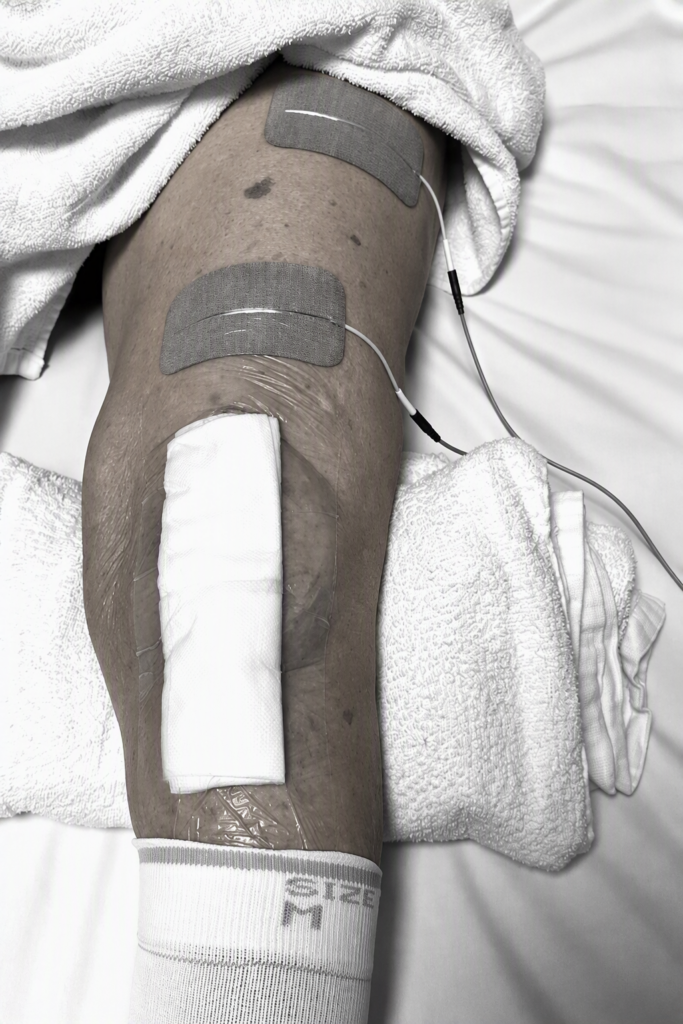
N.B This is a typical protocol only, seek guidance from your therapist for exact application advice post surgery.
Practical Tips
To maximise outcomes:
- Aim for a strong visible contraction
- Encourage active participation during stimulation
- Combine NMES with strengthening exercises
- Progress rehabilitation based on functional goals
- Monitor patient comfort and skin integrity
NMES should form part of a comprehensive rehabilitation programme rather than being used in isolation.
Conclusion
Quadriceps weakness remains one of the most significant barriers to successful recovery following total knee replacement. Arthrogenic muscle inhibition, reduced activity levels and post-operative muscle loss can all contribute to prolonged deficits in strength and function.
By promoting stronger muscle contractions and improving quadriceps activation, NMES may offer a valuable adjunct to conventional rehabilitation. When combined with progressive exercise therapy, NMES has the potential to support strength recovery, improve functional outcomes and help patients regain confidence in everyday activities sooner.
Research
Paravlic AH, Meulenberg CJ, Drole K. The Time Course of Quadriceps Strength Recovery After Total Knee Arthroplasty Is Influenced by Body Mass Index, Sex, and Age of Patients: Systematic Review and Meta-Analysis. Frontiers in Medicine. 2022.
Sonnery-Cottet B, Hopper GP, Gousopoulos L, Vieira TD, Thaunat M, Fayard JM, et al. Arthrogenic Muscle Inhibition Following Knee Injury or Surgery: Pathophysiology, Classification, and Treatment. Video Journal of Sports Medicine. 2022;2(3)
Stevens-Lapsley JE, Balter JE, Wolfe P, Eckhoff DG, Kohrt WM. Early Neuromuscular Electrical Stimulation to Improve Quadriceps Muscle Strength After Total Knee Arthroplasty: A Randomized Controlled Trial. Physical Therapy. 2012;92(2):210-226. doi:10.2522/PTJ.20110124.
Peng L, Wang K, Zeng Y, Wu Y, Si H, Shen B. Effect of Neuromuscular Electrical Stimulation After Total Knee Arthroplasty: A Systematic Review and Meta-analysis of Randomized Controlled Trials. Frontiers in Medicine. 2021
Cheuy VA, Dayton MR, Hogan CA, Graber J, Anair BM, Voigt TB, et al. Neuromuscular Electrical Stimulation Preserves Muscle Strength Early After Total Knee Arthroplasty: Effects on Muscle Fiber Size. Journal of Orthopaedic Research. 2022
Sakai, S., Watanabe, M., Itoh, Y., Sato, N., Hamaguchi, N., & Fukuta, M. (2025). Effects of neuromuscular electrical stimulation on quadriceps muscle strength in the early postoperative period after total knee arthroplasty. Physical Therapy Research, 28(1), 54-60.
 Company Registration #05329639